
[Trademark] Similarity Between Goods and Services
When seeking trademark protection, how is the similarity between the designated goods or services of a trademark application and those covered by a prior trademark determined?
In Japan, the similarity of goods and services is assessed by the Japan Patent Office (JPO) in accordance with the Examination Guidelines for Similar Goods and Services. Under these guidelines, goods and services are categorized into specific groups, each assigned a five-character similar group code consisting of numbers and letters.
As a matter of examination practice, goods or services bearing the same similar group code are generally presumed to be similar, while those assigned different codes are generally presumed to be dissimilar. Overcoming these presumptions during prosecution can be challenging.
How, then, are such issues treated at the invalidation trial stage and in actions for rescission of trial decisions?
In the invalidation trial discussed below (Invalidation Trial No. 2023-890053), the key issue was whether “medical apparatus and instruments, other than walking aids, and crutches” (Similar Group Code 10D01) and “rental of medical machines and apparatus” (Similar Group Code 42X09) , designated under the same trademark, should be regarded as similar goods and services.
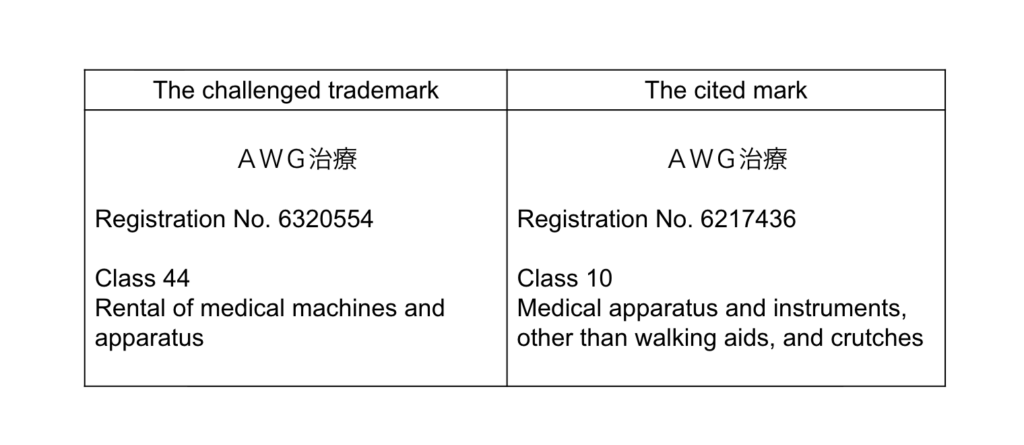
Initially, the decision of the invalidation trial held that these designated goods and services were dissimilar, based on a comprehensive assessment made in light of the ordinary and established realities of trade.
However, in an action seeking the rescission of this decision, the IP High Court determined that the two were similar for the following reasons. As a result, in the remanded proceedings, the registration of the mark at issue was invalidated with respect to “rental of medical machines and apparatus.”
There are numerous instances in which the rental of medical apparatus and instruments, on the one hand, and the manufacture and sale of medical apparatus and instruments, on the other, are conducted by the same business entity. In addition, these services and goods share the same purpose, their places of provision and sale are often identical, and their respective groups of consumers substantially overlap. In light of these market realities, where marks of an identical composition are used for the designated service of rental of medical apparatus and instruments and for the designated goods of medical apparatus and instruments, there is a likelihood that traders and consumers would mistakenly believe that the goods and services originate from, or are provided by, the same business entity. Therefore, the designated service of rental of medical machines and apparatus and the designated goods of medical apparatus and instruments should be regarded as similar.
(Excerpted from the summary of the Intellectual Property High Court judgment in Reiwa 6 (Gyo-Ke) No. 10028)
This case is somewhat unique in that it concerned medical goods and services and ultimately reached the IP High Court. Nevertheless, it demonstrates that, even where different Similar Group Codes are assigned to the relevant goods and services, similarity between them may still be found based on the specific realities of the marketplace and actual trading conditions.
Although Similar Group Codes serve as an important indicator in determining the similarity of goods and services, they are not conclusive. In particular, in trial and court proceedings, evidence of actual market conditions and trade practices can prove decisive. Therefore, parties should not assume that a finding of similarity is impossible simply because the goods or services are assigned different Similar Group Codes. Instead, they should actively collect and present evidence demonstrating the realities of the marketplace and use such evidence to support their arguments.
——
Written by Emi Ashihara, Patent and Trademark Attorney, General Manager of Trademark Group