
[Trademark] Does the Ichimatsu Pattern Infringe Trademark Rights?
— A JPO Advisory Opinion on the Scope of Louis Vuitton’s “Damier” Trademark Rights —
(Advisory Opinion No. 2020-695001)
◆ Overview of the Case
This case concerns whether a checkered pattern mark (the “Mark in Question”) used on products such as prayer bead pouches, sutra book covers, and goshuin book holders by Kobe Juzu Store Co., Ltd. (the “Demandant”) falls within the scope of trademark rights of International Registration No. 952582 (the “Registered Mark”), owned by Louis Vuitton Malletier (“Louis Vuitton”), commonly known as the “Damier” pattern.
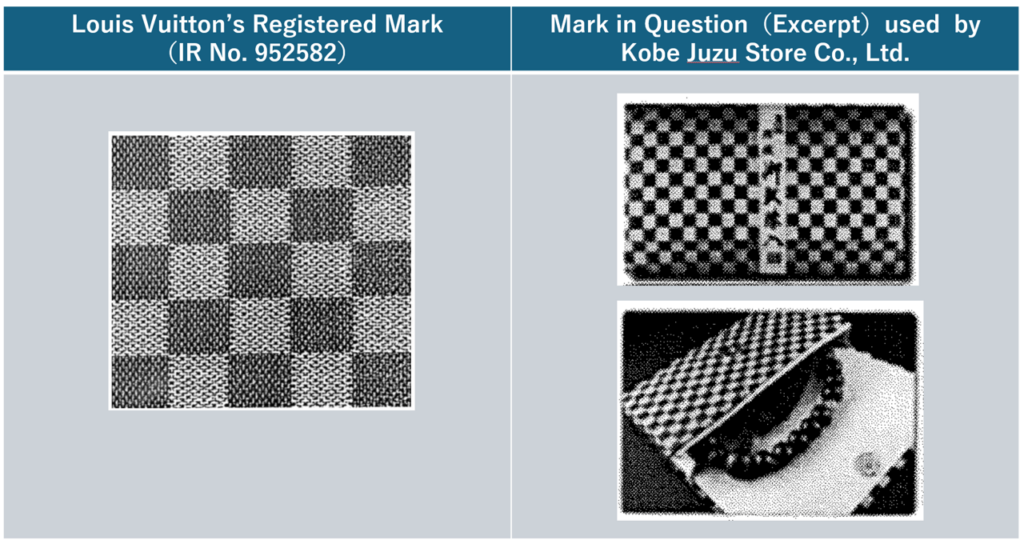
(Source: J-PlatPat)
The dispute arose when the Demandant used an Ichimatsu (checkered) pattern textile on its pouch products, and Louis Vuitton notified the Demandant’s business partner that the sale of such products constituted trademark infringement. As a result, the business partner suspended sales of the products.
Subsequently, in order to confirm the validity of the allegation and to resume sales through the business partner, the Demandant filed a request for an advisory opinion with the Japan Patent Office (JPO).
◆ Conclusion
The JPO concluded that the use of the Mark in Question does not fall within the scope of the trademark rights of Louis Vuitton’s Registered Mark.
◆ Key Points
(1) The Ichimatsu Pattern as a Traditional and Well-Known Design
The Mark in Question was recognized as being of the same nature as the traditional Japanese “Ichimatsu” pattern, which consists of alternating squares or rectangles of different colors arranged in a checkerboard fashion. This pattern has long been widely known and used in Japan.
(2) Not Used to Distinguish Source
The Mark in Question appeared as a pattern covering the entire surface of the pouch products. In addition, product descriptions in brochures referred to the pattern as “Ichimatsu pattern” or “checkered pattern.”
Accordingly, the JPO found that consumers would perceive the pattern merely as a fabric design, rather than as an indication of the source of the goods. Therefore, the Mark in Question was not used in a manner that functions as a trademark.
(3) Article 26(1)(vi): No Similarity Analysis Required
The JPO determined that the Mark in Question falls under Article 26(1)(vi) of the Trademark Act, as it was not used in a way that allows consumers to recognize the source of the goods.
Therefore, there was no need to examine the similarity between the marks or the goods, and the trademark rights were held not to extend to the Mark in Question.
◆ A Final Note
This case highlights that the key issue was whether the mark was used “as a trademark.” It clarifies that the use of a widely recognized traditional pattern merely as a design element does not constitute trademark infringement.
In practice, receiving a warning from a well-known brand may be surprising. However, it is important to carefully assess the substance and legal validity of such claims. The JPO’s advisory opinion system provides an opportunity to obtain impartial and expert determinations in such disputes, which is of considerable practical importance.
—
Written by Mamiko Yoshida, Patent and Trademark Attorney, Trademark Group